
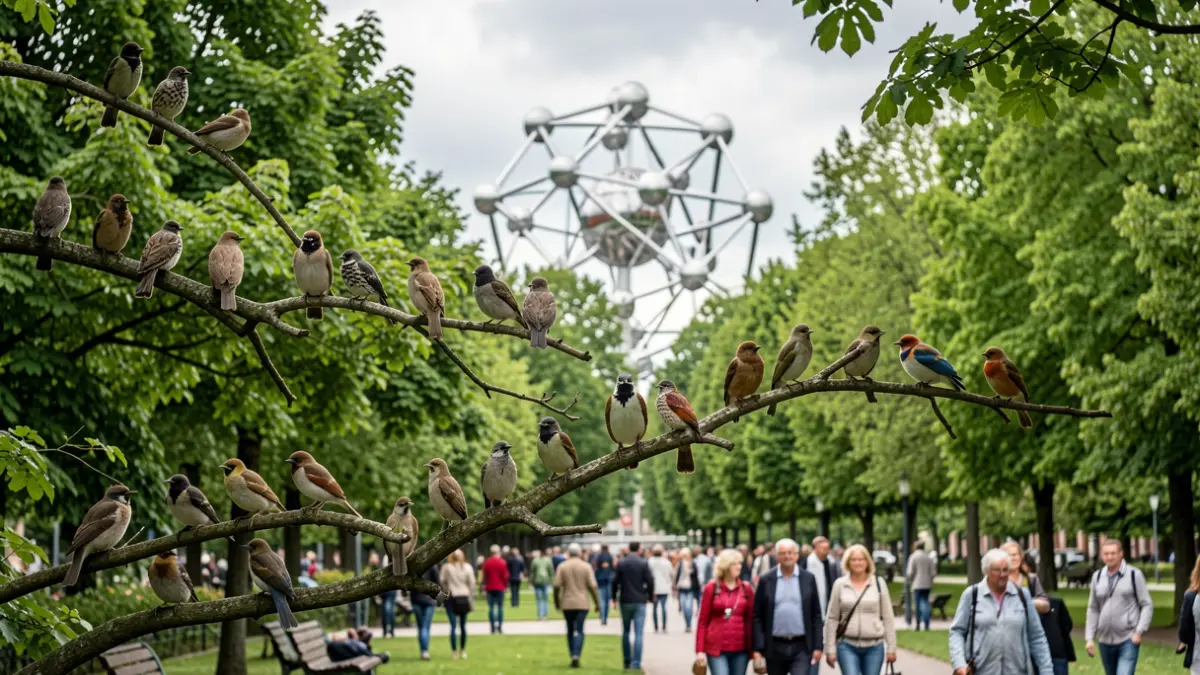
A recent study on the evolution of bird fauna in the Brussels-Capital Region highlights a concerning decline for nearly 40% of the studied species. Out of about forty common bird species for which a trend can be established, 16 are in regression. Furthermore, at least 6 other native species, once common, are now seriously threatened. The bird species most affected by this long-term decline are those nesting in buildings and migratory birds.
Conversely, a generally favorable trend is observed for exotic species and corvids. Birds, as excellent biodiversity indicators, react quickly to environmental changes due to their great dispersal capacity and their presence in various biotopes, including urbanized environments. Their ease of observation makes them ideal subjects for biodiversity monitoring.
The monitoring of Brussels' birdlife, primarily carried out by Aves (the ornithological hub of Natagora) for Leefmilieu Brussel, employs various methods. These include the creation of distribution atlases (every 15-20 years), annual monitoring of general populations or specific groups (such as water birds), as well as targeted scientific studies and the monitoring of species of community and regional importance.
The analysis of common breeding bird monitoring data, organized since 1992 using the "luisterpunt" method (inventory of birds heard or seen for 15 minutes at fixed sites), reveals that for the period 1992-2024, a statistically significant trend was observed for 41 species. Among these, one species (2.4%) is in sharp decline: the house sparrow (Passer domesticus). Fifteen species (36.6%) are declining, 15 (36.6%) are stable long-term, 8 (19.5%) are increasing (including 2 exotic species: the ring-necked parakeet and the pheasant), and 2 (4.9%) are sharply increasing, including one exotic species: the Egyptian goose.
It is important to note that this assessment only covers a portion of the birdlife, primarily the most widespread breeding species. Less common species or those with highly variable annual populations are not included. Furthermore, a large number of species not monitored by the luisterpunt method, often those with higher ecological requirements, show a decline at the regional level. Generalist species, which are less demanding, such as pigeons and corvids, adapt better to the urban environment, with a notable increase in the population of carrion crows.
Several factors contribute to this decline, including the reduction and fragmentation of green spaces, the scarcity of food resources (decrease in insect populations), pollution (including pesticides), climate change, building renovations limiting nesting sites for cavity-nesting species, and avian epizootics such as the Usutu virus.