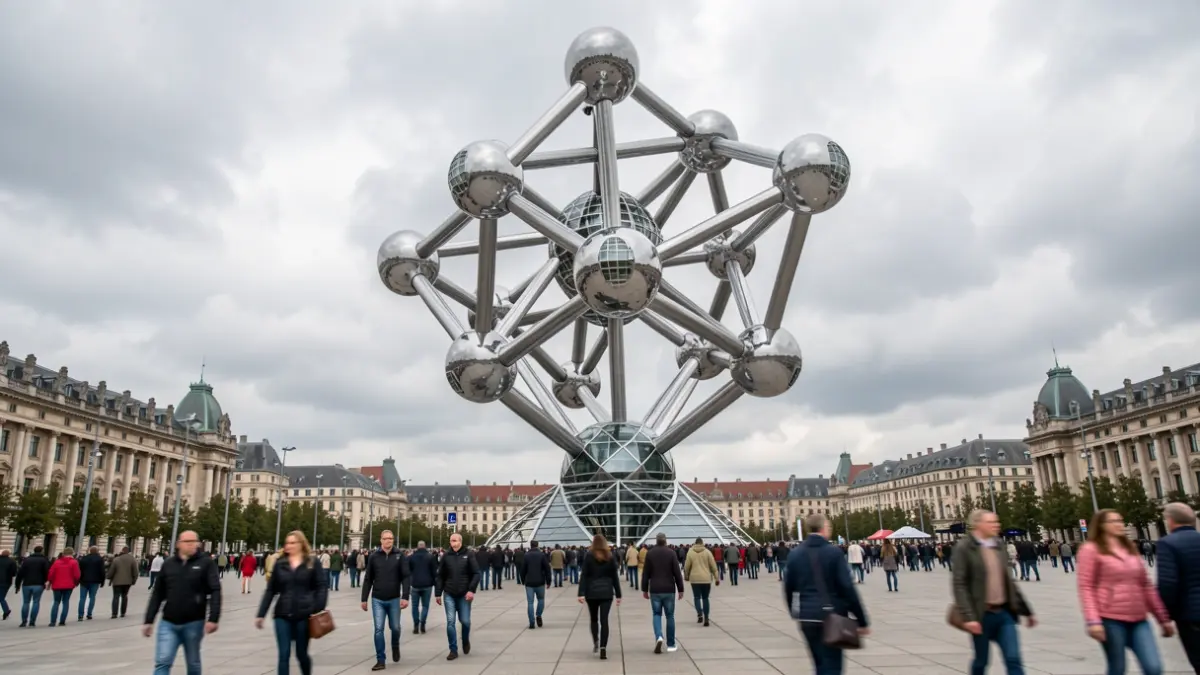
From Friday, September 25 to Saturday, September 26, the Atomium will be the venue for WiseNight 2026, a free and interactive science event organized as part of European Researchers’ Night. The Vrije Universiteit Brussel (VUB) is organizing the event in collaboration with the ULB, BeWiSe, GoodPlanet, and the von Karman Institute, and it is funded by the European Union.
Over the course of two days, visitors will not only be able to observe science but above all to experience it for themselves through experiments, workshops, demonstrations, and meetings with researchers. Topics ranging from climate and artificial intelligence to space, mathematics, technology, and their everyday applications will be covered. WiseNight aims to show just how broad the field of science is and how many different talents, perspectives, and people are needed to develop new knowledge.
For the VUB, this interaction between science and society is a key part of its social mission. Research does not stop at the boundaries of the laboratory or the university. By bringing researchers into direct contact with young people, families, teachers, and the wider public, WiseNight aims not only to make scientific knowledge accessible but also to show who is behind science, what questions researchers are exploring, and who might become a scientist themselves one day.
WiseNight places a particular focus on female researchers, diversity, and talent development in STEM (Science, Technology, Engineering, and Mathematics). This is deliberate, aiming to broaden the often-limited view young people have of what a scientist is or can be. Together with its sister university, the ULB, the VUB is bringing a large number of female researchers to the Atomium, with a wide range of expertise and career paths. They will talk not only about their research findings but also about the questions that drive them, their discoveries, their doubts, and their journey as researchers.
Symbolically, the Atomium’s Ilya Prigogine sphere will be temporarily renamed the Marie Skłodowska-Curie sphere. This tribute aims to highlight the visibility of women in science and technology and coincides with the 30th anniversary of the Marie Skłodowska-Curie Actions (MSCA) programme, funded by the EU's Horizon Europe programme.
Among the VUB researchers participating are Lesley De Cruz (meteorology, AI, climate), who received the Brussels Women Award in Technology and Science (WATS) in 2025. Hannelore Van Bavel (social anthropology, gender, and intersectionality) will explore perceptions of women's bodies. Yuxin Pu (urban geography, sustainability) will discuss research on the city of tomorrow. Kateryna Osadcha will cover artificial intelligence and education, while Nanoek Bos (media studies) will examine the interplay between science, media, and society. Katrien Dierickx (bioarchaeology) and Mishka Beutels (palliative care) will also be present.
On Friday, September 25, 400 pupils from Dutch- and French-speaking schools in and around Brussels will be welcomed to participate in workshops, demonstrations, and presentations, engaging directly with female researchers. The VUB considers this science communication essential for showing that research stems from curiosity and the ambition to solve societal issues.