
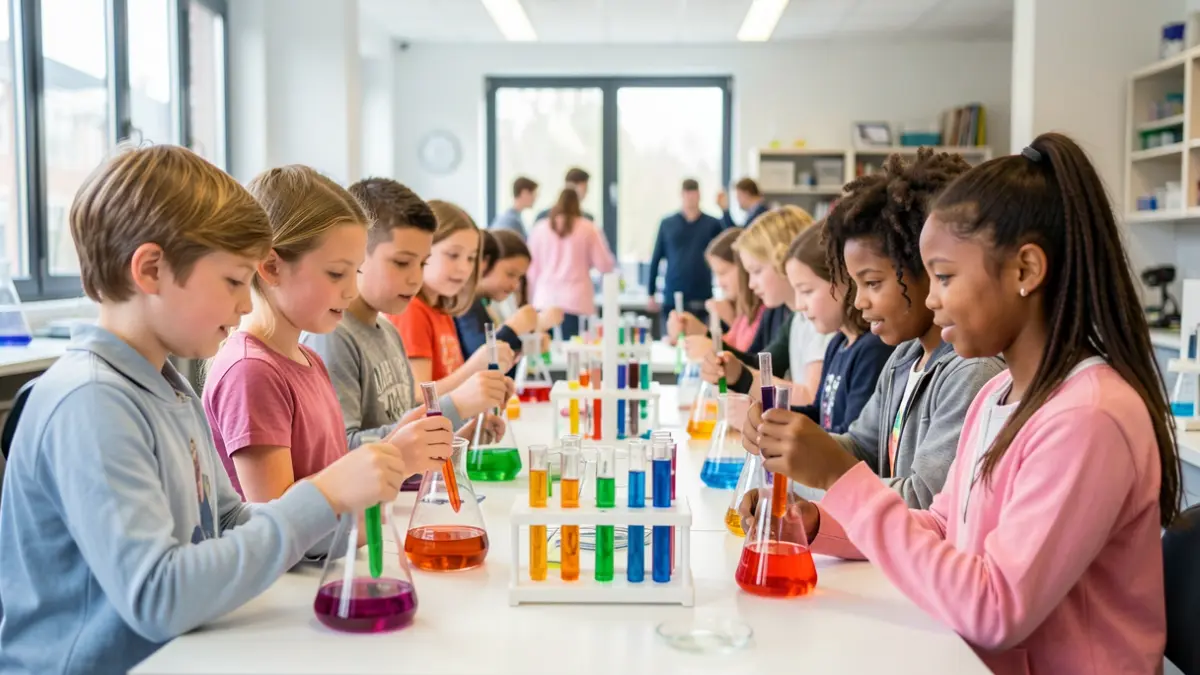
Generalized measures aimed at increasing the motivation and interest of secondary school students in STEM (Science, Technology, Engineering, Mathematics) fields can gain effectiveness when they consider differences between school contexts and student groups. This is according to new research published by the Vrije Universiteit Brussel (VUB). The study shows that differences in STEM motivation, interest, and identity, and their correlation with factors such as gender, field of study, and year level, do not follow the same pattern in every school context. The researchers therefore emphasize the importance of a context-sensitive approach, where general STEM measures allow sufficient room for adaptation to the specific school context and student groups.
The research, conducted by Christophe Kegels under the supervision of prof. Valérie Thomas (Brussels Innovation for Learning and Diversity Research Centre, VUB) and in collaboration with dr. Haydée De Loof (KdG), compared fifth and sixth-year secondary school students in the Antwerp Kempenrand region. The results indicate that general assumptions about STEM motivation are not readily applicable to every school in practice. For instance, a pronounced difference in STEM identity between boys and girls was discovered in one school, while this difference was entirely absent in a comparable other school. The assumption that STEM motivation decreases with age also proved incorrect: in one school, sixth-year students indeed scored lower than fifth-year students, but in another school, the interest and intrinsic motivation among the older students were significantly higher.
According to researcher Christophe Kegels, this clearly shows that each school must be approached as a unique ecosystem. Simply rolling out general interventions or mandatorily focusing on specific target groups, such as only girls, can even have a counterproductive effect in certain schools. "When schools want to improve educational quality and STEM outflow, they must first map the specific needs of their own students," explains Kegels. "A standard package of measures simply does not work because the starting positions of schools differ too much."
The research is part of a broader initiative under the impetus of prof. Hugo Thienpont (B-PHOT VUB) and the Helios Foundation. To sustainably increase enrollment in STEM programs and measure the impact of initiatives, a new STEM Academie is being built in the Zenne Valley (specifically in Gooik). Within the doctoral track, both extracurricular year-long projects – such as building robots in collaboration with industrial partners like Siemens, Colruyt Group, and Velleman – and short-term school interventions are being evaluated for their effectiveness.
To directly support teachers and policymakers with scientifically based tools, the VUB researchers are currently working on finalizing a practical guide. The guide will help teachers integrate directly applicable and effective working methods into the classroom, tailored to specific learning objectives and the diversity of their student population.