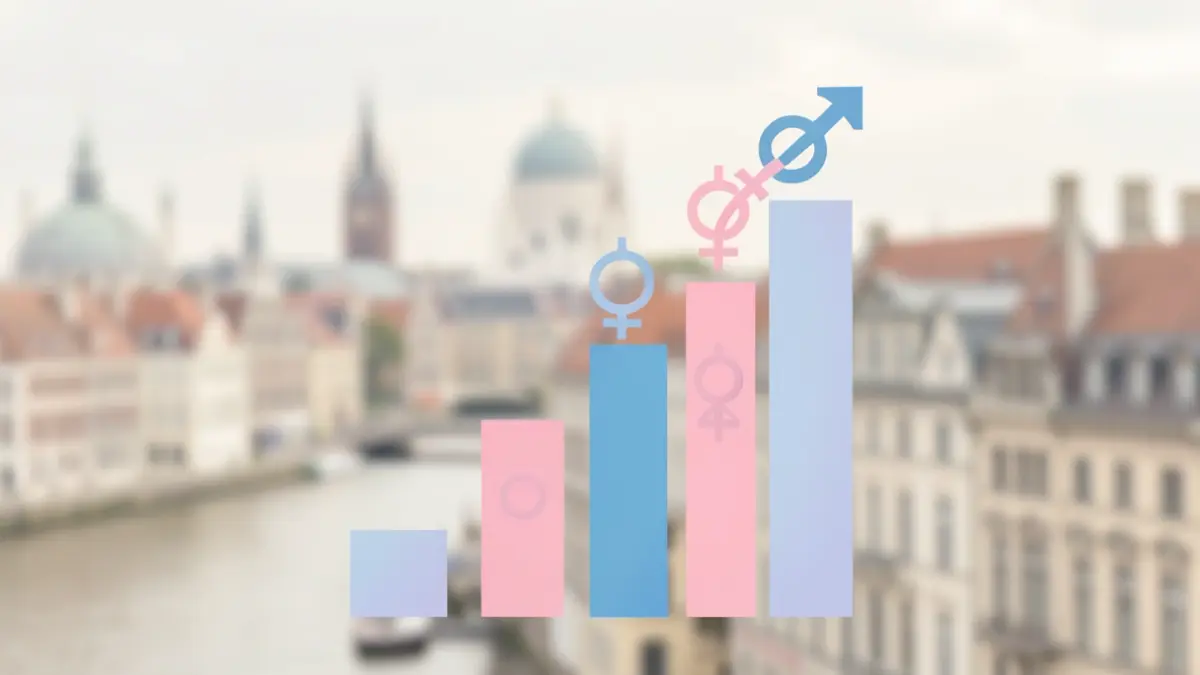
The European Institute for Gender Equality (EIGE) published its 2026 Gender Equality Index on November 17, 2026. Belgium achieved a score of 70.1 out of 100, well above the European average of 64.5 points. It moved up one place to 6th among EU member states. However, women's political power decreased by 13.9 points, the largest drop recorded across the Index's dimensions.
Compared to 2025, Belgium gained 1.4 points, widening the gap with the EU average to 5.6 points. Progress exceeded the EU average in most domains, except for knowledge and health.
In the Power domain (54.6 points; +4.7 points), progress is mainly driven by social power (+14 points). Women now represent 30% of the highest decision-making bodies in the ten most popular national Olympic sports organisations, an 8 percentage point increase. Politically, they are well-represented in regional and local assemblies (47%), the federal parliament (44%), and the boards of the largest listed companies (39%). Conversely, the share of women ministers dropped from 55% to 27% after the federal government formation in February 2025, causing the political power score to fall.
Financial Equality reached 81.2 points (+2.2). The gender pension gap narrowed to 27%, still above the EU average (24%). Income disparities are reflected in couples: women in couples earn on average 84% of their male partner's income, one of the highest rates in the EU. Men in couples have an average income equivalent to 124% of their female partner's, illustrating persistent economic inequalities.
The Work domain scored 71.5 points (+1.3). The employment rate in full-time equivalents is among the lowest in the EU for both women (42%) and men (54%). Women hold 37% of management positions (+3 percentage points) but only 18% of ICT jobs (-1 point). 35% of women earn at most two-thirds of the median salary, compared to 31% of men; this gap has reduced, but low pay has increased for both sexes.
Education saw a decrease to 54.5 points (-1.8), mainly due to the widening gap in educational attainment: 60% of women aged 30-34 are higher education graduates versus 46% of men. This gap is significantly larger than the EU average. Only 28% of STEM graduates are women, compared to the EU average of 34%.
Time Use remained stable at 76.3 points, with Belgium ranking second in Europe. However, inequalities persist in the division of domestic chores (50% of women vs. 27% of men do chores daily) and leisure time (43% of men spend over 8 hours/week on leisure vs. 34% of women). The time spent on long-term care is balanced (10% for both sexes).
Health slightly declined to 86.1 points (-0.1), linked to women's less favourable perception of their health (71% vs. 77% for men). Healthy life years after 65 continue to increase for both genders.
In the domain of violence against women, Belgium scored 25.9 points (less unfavourable than the EU average of 31.9). Nearly 29% of women have experienced physical and/or sexual violence since age 15, with 60% reporting health consequences. Cyberbullying is more frequent among girls, and 8% of women who have worked experienced sexual harassment at work via social media.
Regarding parental leave, 16% of women and 18% of men in employment lack access, mainly due to self-employment status or not meeting employment conditions. Overall, 41% of women and 37% of men do not qualify for parental leave benefits.
Belgium continues to outperform the EU average and further strengthens its lead. However, the 2026 Index highlights the fragility of this progress, particularly the impact of reduced female representation in the federal government. Binding mechanisms, such as the transposition of the EU 'Women on Boards' directive with quotas of 40% for boards and 33% for management committees, appear more sustainable. The Council of Ministers approved a draft bill in this regard in July 2026.
Significant challenges remain in other areas: the pension gap, lower pay for women, gendered labour markets and study fields, women's lower health perception, and widespread violence.